
Convert your VirtualDJ library to Serato DJ with Lexicon. Playlists become crates, Filter Folders become Smart Crates, hot cues transfer. Free, Windows and macOS.
Applies to any recent VirtualDJ → Serato DJ Pro or Lite (versions 3 and 4).
Requirements
You need to have these installed:
- VirtualDJ
- Serato DJ Pro or Lite, launched at least once
- Lexicon - free for library conversion
Lexicon runs on Windows and macOS.
Steps to convert VirtualDJ to Serato
The process has two parts: import your VirtualDJ library into Lexicon, then sync it to Serato.
Part 1 - Import from VirtualDJ
- Close both VirtualDJ and Serato completely. Background processes must terminate for the databases to be readable.
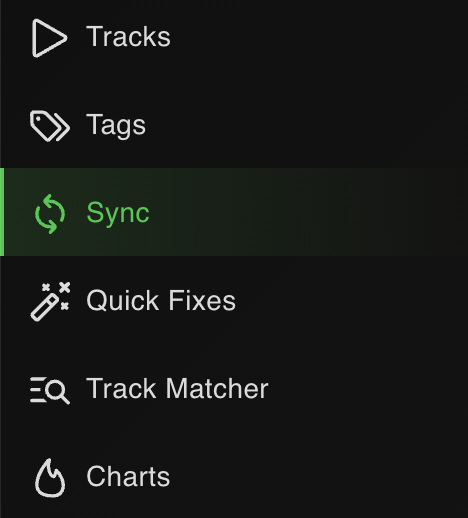
- Open Lexicon and go to the Sync page.
- Click
Import tracks & playlistsat the bottom.

- Choose VirtualDJ from the dropdown. Lexicon auto-detects the database.

- Leave
Fullselected to import your entire library.

- Click
Start importing. Your VirtualDJ library now lives in Lexicon.

Part 2 - Sync to Serato
- Go back to the Sync page (don't click Import again).
- Choose Serato from the dropdown. Lexicon auto-detects the Serato database.

- Leave
Fullselected. Leave the other options on their defaults.

- Click
Sync to Serato. Wait for it to finish.

When it completes, open Serato and your full library is there - playlists, cues, beatgrids and tags intact.
What transfers from VirtualDJ to Serato
| Item | Transfers | Notes |
|---|---|---|
| Playlists & folder structure | Yes | VirtualDJ playlists become Serato crates. Folder hierarchy maps to Serato subcrates. |
| Filter Folders | As Smart Crates | VirtualDJ Filter Folders pass through Lexicon as smartlists and sync to Serato Smart Crates. |
| Virtual Folders | As normal crates | Serato has no Virtual Folders concept, so they sync as normal crates. |
| Hot cues | Yes | Both apps support 8 hot cues. |
| Cue colors | Yes (if set in VirtualDJ) | VirtualDJ stores cue colors in the POI editor. Serato displays them. |
| Beatgrids | Yes | Beatgrid markers and BPM transfer. |
| Loops | Yes | Saved loops transfer. |
| Tracks in parent folders | As _FolderTracks playlist |
Both apps allow tracks directly in parent folders, but Lexicon normalizes this into _FolderTracks playlists for consistency. |
| Track metadata | Yes | Title, artist, album, genre, BPM, key, comments, ratings, custom tags. |
| Album art | Yes | Embedded art transfers. |
| Streaming tracks | Conditional | Both VirtualDJ and Serato support streaming tracks (Beatport, Tidal, etc.). The streaming service must be enabled in both apps for the tracks to appear after sync. Serato 3 does not support streaming tracks in crates - use Serato 4. |
Notes specific to VirtualDJ → Serato
Filter Folders → Smart Crates
VirtualDJ Filter Folders become Lexicon smartlists, which sync to Serato Smart Crates. Rules that don't translate cleanly are simplified.
Cue colors carry across
Even though VirtualDJ's main UI doesn't display cue colors, the POI editor stores them. Those colors sync through Lexicon to Serato, where they're visible.
Disable VirtualDJ auto-tag-read
If VirtualDJ is set to auto-read ID3 tags, your tags may have been overwritten before Lexicon imports. Disable auto-update in VirtualDJ settings and verify your tags before importing.
Tracks placed directly in VirtualDJ folders
VirtualDJ allows tracks directly in a folder. Both Serato and Lexicon normalize this into per-folder _FolderTracks playlists.
Serato 3 vs Serato 4
Both are supported. Serato 4 handles streaming tracks (Beatport, Tidal, etc.) in crates; Serato 3 does not. VirtualDJ supports streaming too, so if you want those tracks in Serato after sync, use Serato 4 and make sure the streaming service is enabled in both apps.
Serato backups are automatic
Before Lexicon writes to Serato, it backs up the crate files and database to Music/_Serato_/Lexicon.
Frequently asked questions
Will VirtualDJ cue colors appear in Serato?
Yes. VirtualDJ stores cue colors in its POI editor, and Serato displays them after sync.
What happens to Filter Folders in Serato?
They become Smart Crates via Lexicon smartlists.
Does this work with Serato 4?
Yes. Lexicon supports Serato 3 and 4, both Pro and Lite.
Why is there a _FolderTracks crate in Serato?
VirtualDJ allows tracks to sit directly inside a folder. Lexicon normalizes this by collecting them into a _FolderTracks playlist per folder, which syncs to a Serato crate.
Does this work on macOS?
Yes. The process is identical on Windows and macOS.
Other conversion guides
Converting from a different app, or to a different app?
Thoughts? Questions? Share them on the forum or chat about them on Discord.